My Windows Journey
I still remember when our company switched from Windows XP to Windows 7. Windows 7 remains the best OS from Microsoft after Windows XP—stable, intuitive, and respectful of user preferences.
Windows 10 was a nightmare from the beginning. There were constant file corruptions, Office software refusing to start even after IT reinstalls, and inexplicable system issues. No one could explain why. It eventually stabilized after about a year and worked smoothly for my daily work. Although I’m primarily a Linux user, I need Windows for daily work. I maintain a separate Linux machine for software development.
After two or three years on Windows 10, mandatory upgrades pushed us to Windows 11. In my opinion, it’s in a junk state. The second-level right-click menu is particularly frustrating—forcing users to adapt to Microsoft’s design choices rather than providing options. This forced adaptation philosophy pervades the entire OS. I started hating Windows 11, especially when File Explorer takes 10+ seconds to open on a freshly booted laptop.
The Annoying Language Bar Problem
Windows 11 introduced a persistent language bar indicator that many users find intrusive. This small window appears in the taskbar or system tray, showing your current input method.
The most frustrating part? You cannot find a button to hide it from the language bar’s own menu. Microsoft removed the obvious toggle that existed in previous Windows versions, forcing users to hunt through multiple settings menus to disable it.
Why Microsoft Added This
Microsoft’s reasoning for the persistent language bar:
- Multi-language Support: Useful for users frequently switching between input methods (English, Chinese, Japanese, etc.)
- Touch Input: Designed for touchscreen devices where language switching is more common
- Accessibility: Makes input method status visible at all times
However, for users who only use one input language or prefer a clean taskbar, it’s unnecessary clutter.
The Hidden Solution
After digging through Windows 11’s convoluted settings, here’s how to hide it:
Step-by-Step Instructions
-
Open Settings: Press
Win + Ior click Start → Settings - Navigate to Time & Language:
- Click “Time & language” in the left sidebar
- Select “Typing” from the options
- Access Advanced Keyboard Settings:
- Scroll down to find “Advanced keyboard settings”
- Click to expand this section
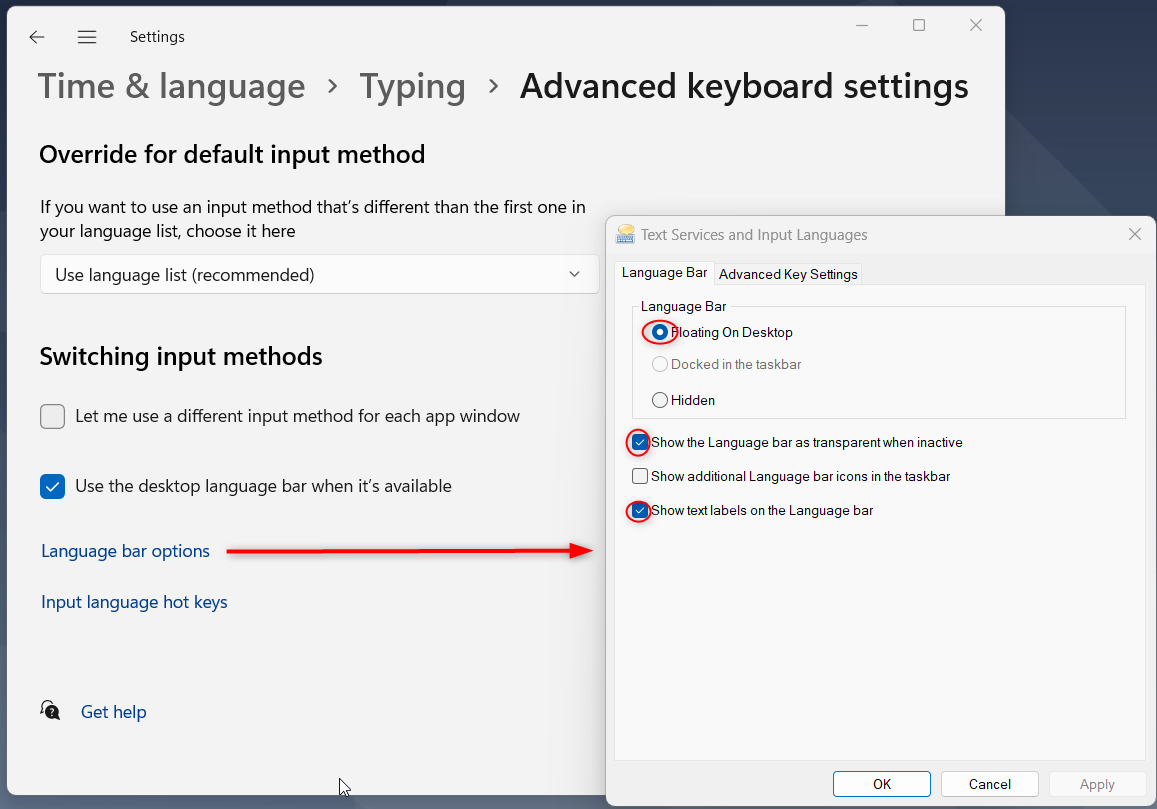
- Configure Language Bar Options:
- Look for “Language bar options” (this might require clicking “Input language hotkeys” first in some builds)
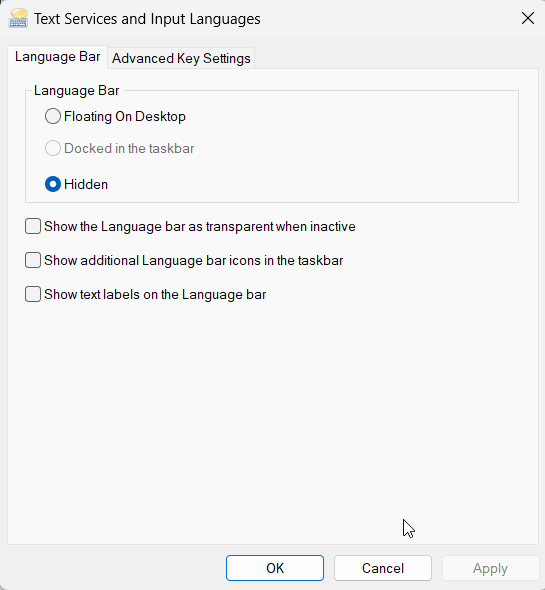
- In the Language Bar dialog, select “Hidden”
- Deselect all other options including:
- “Show the Language bar as transparent when inactive”
- “Show additional Language bar icons in the taskbar”
- “Show text labels on the Language bar”
- Apply Changes: Click “OK” and “Apply”
Alternative Method via Registry (Advanced)
For power users comfortable with registry editing:
1. Press Win + R, type "regedit", press Enter
2. Navigate to: HKEY_CURRENT_USER\Software\Microsoft\CTF\LangBar
3. Set "ShowStatus" to 3 (Hidden)
4. Restart Explorer or log out/in
Warning: Registry editing can cause system issues if done incorrectly. Backup your registry first.
Command-Line Method (PowerShell)
# Run PowerShell as Administrator
Set-ItemProperty -Path "HKCU:\Software\Microsoft\CTF\LangBar" -Name "ShowStatus" -Value 3

# Restart Explorer
Stop-Process -Name explorer -Force
Related Windows 11 Annoyances and Fixes
Since we’re on the topic of Windows 11 frustrations, here are other common issues:
1. Restore Right-Click Context Menu
Windows 11’s simplified right-click menu hides useful options:
reg.exe add "HKCU\Software\Classes\CLSID\{86ca1aa0-34aa-4e8b-a509-50c905bae2a2}\InprocServer32" /f /ve
Restart Explorer to restore the full Windows 10-style context menu.
2. Taskbar Always Show All Icons
Windows 11 hides system tray icons by default. To show all:
- Settings → Personalization → Taskbar
- Click “Other system tray icons”
- Enable all desired icons
3. Disable Web Search in Start Menu
Stop Windows from sending your searches to Bing:
# PowerShell as Administrator
reg add HKCU\Software\Policies\Microsoft\Windows\Explorer /v DisableSearchBoxSuggestions /t REG_DWORD /d 1 /f
4. Remove Recommended Section from Start Menu
The “Recommended” section clutters the Start menu:
- Settings → Personalization → Start
- Toggle off “Show recently opened items”
5. Make File Explorer Open to “This PC”
Instead of “Quick Access”:
- Open File Explorer
- Click “…” (three dots) → Options
- In “Open File Explorer to”, select “This PC”
Why Windows 11 Frustrates Power Users
Microsoft’s design philosophy in Windows 11 prioritizes:
- Simplicity over Functionality: Hiding advanced options to reduce “clutter”
- Touch over Desktop: Optimizing for tablets rather than traditional PCs
- Microsoft Services: Pushing Edge, Bing, Microsoft 365
- Forced Updates: Removing user control over system behavior
This frustrates professionals and power users who:
- Want granular control over their systems
- Use Windows for serious work, not casual browsing
- Don’t need AI assistants and web-integrated features
- Value stability and performance over new UI experiments
Productivity Impact
These UI changes aren’t just aesthetic complaints—they have real productivity costs:
- Context Switching: Extra clicks to access common functions slow down workflows
- Muscle Memory: Years of learned shortcuts and menu locations are invalidated
- Resource Usage: New UI frameworks and background services consume more RAM/CPU
- Distraction: Persistent pop-ups and suggestions interrupt focus
For professionals working with complex software (development environments, CAD, video editing), these interruptions compound throughout the day.
The Linux Alternative
As someone who uses both Windows and Linux, the contrast is stark:
Linux Philosophy:
- User choice paramount
- Customizable to extreme degree
- Minimal by default, add what you need
- Community-driven development
Windows 11 Philosophy:
- Microsoft knows best
- Customization discouraged
- Bloatware included by default
- Corporate profit-driven decisions
For development work, I maintain a dedicated Linux machine. For unavoidable Windows-only tasks (specific corporate software, certain engineering tools), I tolerate Windows 11 with extensive tweaking.
Long-Term Solution: Windows 10
If you can avoid it, don’t upgrade to Windows 11:
- Extended Support: Windows 10 receives security updates until October 2025
- Better Performance: Generally lighter and more responsive
- Familiar UI: No relearning required
- More Control: Fewer restrictions on customization
For organizations, the ROI on Windows 11 upgrades is questionable. The productivity loss from user adjustment time often outweighs any benefits.
Making Peace with Windows 11
If you’re stuck with Windows 11, here’s how to make it bearable:
- Apply all tweaks above to restore sanity
- Use third-party tools:
- Open-Shell (Start menu replacement)
- ExplorerPatcher (restore Windows 10 taskbar)
- PowerToys (Microsoft’s own utility toolkit)
- Disable unnecessary services:
- Xbox services (if not gaming)
- Windows Search (use Everything instead)
- SysMain/Superfetch
- Block telemetry with tools like O&O ShutUp10++
- Use alternative software:
- 7-Zip instead of Windows archiver
- VLC instead of Windows Media Player
- Firefox/Chrome instead of Edge
Conclusion
The Windows 11 language bar is symptomatic of Microsoft’s broader design direction: prioritizing their vision over user choice. While we can work around individual annoyances, the fundamental philosophy remains frustrating for professionals who need efficient, customizable tools.
The solution is buried in settings, but at least it exists. Apply the fix, breathe a sigh of relief, and enjoy your cleaner taskbar—until the next Windows update inevitably resets your preferences.
For development and technical work, I increasingly recommend maintaining a Linux environment alongside Windows, using each OS for what it does best. Windows 11 might be Microsoft’s future, but that doesn’t mean we have to accept every design decision without question.
Quick Reference Card
Hide Language Bar: Settings → Time & Language → Typing → Advanced keyboard settings → Language bar options → Hidden
Restore Right-Click Menu:
reg.exe add "HKCU\Software\Classes\CLSID\{86ca1aa0-34aa-4e8b-a509-50c905bae2a2}\InprocServer32" /f /ve
Disable Web Search:
reg add HKCU\Software\Policies\Microsoft\Windows\Explorer /v DisableSearchBoxSuggestions /t REG_DWORD /d 1 /f
Save these commands—you’ll need them after every major Windows update.
To