Real-Time Rendering: The Graphics Engineer’s Bible
Why This Book Matters
“Real-Time Rendering” by Tomas Akenine-Möller, Eric Haines, and Naty Hoffman is widely considered the definitive reference for computer graphics programming. Now in its fourth edition, it covers everything from fundamental rendering theory to cutting-edge GPU techniques used in modern games and graphics applications.
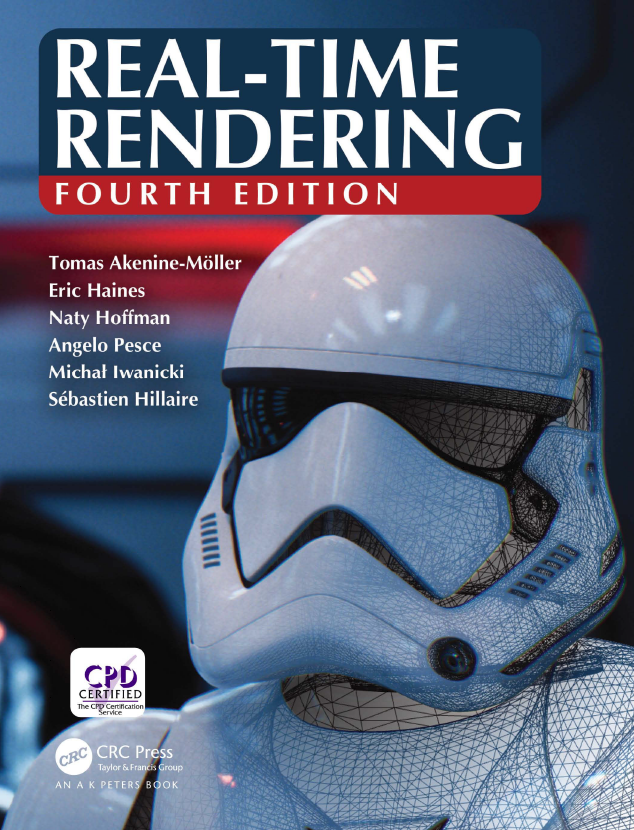
Whether you’re developing game engines, working on automotive visualization systems, building VR/AR applications, or optimizing graphics drivers, this book provides the theoretical foundation and practical insights you need.
What Makes This Book Special
Comprehensive Coverage
The book spans over 1,200 pages covering:
- Graphics pipeline architecture
- Transform mathematics
- Shading and texturing techniques
- Lighting models
- Shadow algorithms
- Global illumination approximations
- Physically-based rendering (PBR)
- GPU optimization
- Intersection testing
- And much more…
Industry-Standard Reference
Used by graphics engineers at major companies:
- Game Studios: Used for engine development at Epic, Unity, EA
- GPU Vendors: Referenced by NVIDIA, AMD, Intel engineers
- Academic: Standard textbook in computer graphics courses
- Film/VFX: Techniques adapted for real-time previsualization
Practical Focus
Unlike purely academic texts, it emphasizes techniques that work in production:
- Real-world performance considerations
- GPU architecture insights
- Trade-offs between quality and speed
- Implementation details and pseudocode
Continuously Updated
The fourth edition (2018) includes modern techniques:
- Physically-based rendering workflows
- Temporal anti-aliasing (TAA)
- Real-time ray tracing fundamentals
- Clustered deferred rendering
- Virtual reality rendering techniques
Key Topics for Different Domains
For Game Engine Developers
Chapter 2 - The Graphics Rendering Pipeline: Understanding the GPU pipeline from vertices to pixels
Chapter 10 - Local Illumination: Implementing efficient lighting models (Phong, Blinn-Phong, Cook-Torrance)
Chapter 11 - Global Illumination: Techniques for approximating indirect lighting (ambient occlusion, light probes, voxel GI)
Chapter 12 - Image-Space Effects: Post-processing techniques (bloom, depth of field, motion blur)
Chapter 14 - Collision Detection: Efficient algorithms for physics and gameplay
For Automotive/Embedded Graphics
Chapter 3 - The Graphics Processing Unit: Understanding GPU architecture for optimization
Chapter 18 - Pipeline Optimization: Memory bandwidth, draw call reduction, instancing
Chapter 23 - Graphics Hardware: Understanding different GPU architectures (important for embedded GPUs)
Automotive visualization systems need to balance visual quality with real-time constraints, making these chapters critical.
For VR/AR Developers
Chapter 8 - Area and Environmental Lighting: Efficient environment mapping for immersive worlds
Chapter 9 - Shadows: High-performance shadow techniques crucial for presence
Chapter 21 - Curves and Curved Surfaces: Tessellation for detailed geometry without excessive polygons
VR requires maintaining 90+ FPS at high resolutions, making optimization chapters essential.
For Low-Level Graphics Programmers
Chapter 3 - GPU Architecture: How modern GPUs execute shaders
Chapter 15 - GPU Programming: GPGPU techniques, compute shaders
Chapter 18 - Pipeline Optimization: Understanding bottlenecks and profiling
Critical for driver development, GPU compute, or graphics API implementation.
Modern Graphics Techniques Covered
Physically-Based Rendering (PBR)
PBR has revolutionized game graphics by using physically accurate material properties:
Metallic Workflow: Albedo + metallic + roughness maps Specular Workflow: Diffuse + specular + glossiness maps Energy Conservation: Ensuring physically plausible material responses
The book explains the theory behind PBR and practical implementation details.
Image-Based Lighting (IBL)
Using environment maps for realistic lighting:
- Environment map capture and storage
- Importance sampling for specular reflections
- Irradiance maps for diffuse lighting
- Split-sum approximation for real-time IBL
Temporal Techniques
Leveraging information from previous frames:
- Temporal Anti-Aliasing (TAA): Accumulating samples over time
- Temporal Upsampling: Rendering at lower resolution
- Motion Vectors: Tracking pixel movement between frames
These techniques enable high-quality visuals at lower computational cost.
Screen-Space Techniques
Image-space effects that operate on rendered images:
- SSAO: Screen-space ambient occlusion
- SSR: Screen-space reflections
- SSGI: Screen-space global illumination
These provide approximations of expensive effects at real-time speeds.
The Rendering Pipeline: A Quick Overview
The book thoroughly explains the modern graphics pipeline:
Application Stage (CPU)
    ↓
Geometry Stage (GPU)
    ├─ Vertex Shader
    ├─ Tessellation (optional)
    ├─ Geometry Shader (optional)
    └─ Clipping & Projection
    ↓
Rasterization Stage
    ├─ Triangle Setup
    ├─ Rasterization
    └─ Fragment Generation
    ↓
Pixel Stage
    ├─ Fragment Shader
    ├─ Depth/Stencil Tests
    ├─ Blending
    └─ Framebuffer Output
Understanding this pipeline is fundamental to graphics programming.
Mathematics Foundation
The book provides essential math without being overwhelming:
Transforms (Chapter 4)
- Translation, Rotation, Scaling: Basic transformations
- Matrix Operations: Composition and optimization
- Quaternions: Efficient rotation representation
- Normal Transforms: Correct normal transformation
Orientation and Viewing (Chapter 5)
- Camera Models: Perspective and orthographic projection
- View Frustum: Defining visible space
- Projection Matrices: GPU-compatible projection
These chapters are crucial for anyone working with 3D graphics.
Practical Applications
Example: Implementing PBR
Following the book’s guidance, a typical PBR shader structure:
// Simplified PBR fragment shader
vec3 albedo = texture(albedoMap, uv).rgb;
float metallic = texture(metallicMap, uv).r;
float roughness = texture(roughnessMap, uv).r;
vec3 normal = getNormalFromMap(normalMap, uv);

vec3 F0 = mix(vec3(0.04), albedo, metallic);

// Cook-Torrance BRDF
vec3 Lo = vec3(0.0);
for(int i = 0; i < numLights; i++) {
    vec3 L = normalize(lights[i].position - fragPos);
    vec3 H = normalize(V + L);

    float NDF = DistributionGGX(normal, H, roughness);
    float G = GeometrySmith(normal, V, L, roughness);
    vec3 F = fresnelSchlick(max(dot(H, V), 0.0), F0);

    vec3 specular = (NDF * G * F) / (4.0 * NdotV * NdotL);
    Lo += (diffuse + specular) * radiance * NdotL;
}

// Add ambient lighting (IBL)
vec3 ambient = calculateIBL(normal, V, albedo, metallic, roughness);
vec3 color = ambient + Lo;
The book explains each component in detail.
Example: Optimizing Draw Calls
Based on Chapter 18’s guidance:
Problem: 10,000+ draw calls causing CPU bottleneck
Solutions:
- Instancing: Render multiple copies with one draw call
- Batching: Combine meshes with same material
- Indirect Drawing: GPU-driven rendering
- Level of Detail: Reduce geometry for distant objects
The book provides algorithmic details for each technique.
Who Should Read This Book
Essential For:
- Game engine developers
- Graphics API programmers (Vulkan, DirectX, Metal)
- Technical artists transitioning to technical roles
- Computer graphics students
- GPU driver developers
Very Useful For:
- Game developers wanting deeper graphics understanding
- VR/AR developers
- Automotive HMI developers
- Scientific visualization programmers
- Anyone working with 3D graphics
Challenging But Rewarding For:
- Self-taught programmers without formal graphics background
- Beginners to graphics programming (supplement with tutorials)
How to Approach This Book
For Beginners
- Start with Chapters 2-5 (pipeline and math fundamentals)
- Read Chapter 10 (basic lighting) carefully
- Implement simple examples as you go
- Skip advanced chapters initially
- Return to deeper topics as your skills grow
For Intermediate Developers
- Focus on chapters relevant to your domain
- Use it as a reference during development
- Deep-dive into optimization chapters
- Study the extensive bibliography for further reading
For Advanced Engineers
- Use as a reference and refresher
- Study cutting-edge techniques in later chapters
- Read cited papers for implementation details
- Contribute to the online discussion forums
Complementary Resources
The book is best used alongside:
Practical Tutorials:
- LearnOpenGL.com (excellent implementation guide)
- RenderDoc (graphics debugging tool)
- Shadertoy (shader experimentation)
Online Resources:
- RealTimeRendering.com - Official website with resources
- Graphics APIs documentation (Vulkan, DirectX, Metal)
- GDC presentations and papers
Related Books:
- “Physically Based Rendering” by Pharr & Humphreys (offline rendering)
- “GPU Gems” series (practical techniques)
- “Game Engine Architecture” by Gregory (broader context)
Staying Current
Graphics technology evolves rapidly. The book’s website provides:
- Updates: Corrections and new technique discussions
- Links: References to latest papers and presentations
- Resources: Code examples and tools
- Bibliography: Extensive references to research papers
Follow the authors on Twitter and read graphics research papers to stay current with post-2018 developments like:
- Real-time ray tracing (DXR, Vulkan RT)
- Machine learning for graphics (DLSS, FSR)
- Nanite-style virtualized geometry
- Lumen-style dynamic global illumination
My Reading Journey
As someone working with QNX and embedded systems, I’m particularly interested in:
Chapter 18 - Optimization: Critical for resource-constrained automotive systems
Chapter 23 - Graphics Hardware: Understanding embedded GPUs used in automotive
GPU Architecture Sections: Relevant to driver optimization and system integration
The book helps bridge my systems programming knowledge with graphics domain expertise needed for automotive display systems.
Conclusion
“Real-Time Rendering” is an investment that pays dividends throughout a graphics programming career. While dense, it’s remarkably readable given the subject matter’s complexity. The authors balance theory with practical advice, making it both a learning resource and a reference manual.
Whether you’re starting in graphics programming or a veteran looking to formalize your knowledge, this book deserves a place on your shelf (or bookshelf app). It’s not a quick read, but the understanding gained is invaluable for anyone serious about real-time graphics.
Access the book and resources at RealTimeRendering.com.
Quick Reference
Beginners Start Here: Chapters 2, 3, 4, 5, 10 Game Developers: Chapters 10, 11, 12, 13, 18 Engine Programmers: Chapters 3, 15, 18, 19, 23 VR Developers: Chapters 9, 11, 18, 21 Graphics API Programmers: Chapters 3, 18, 20, 23
Happy rendering!
